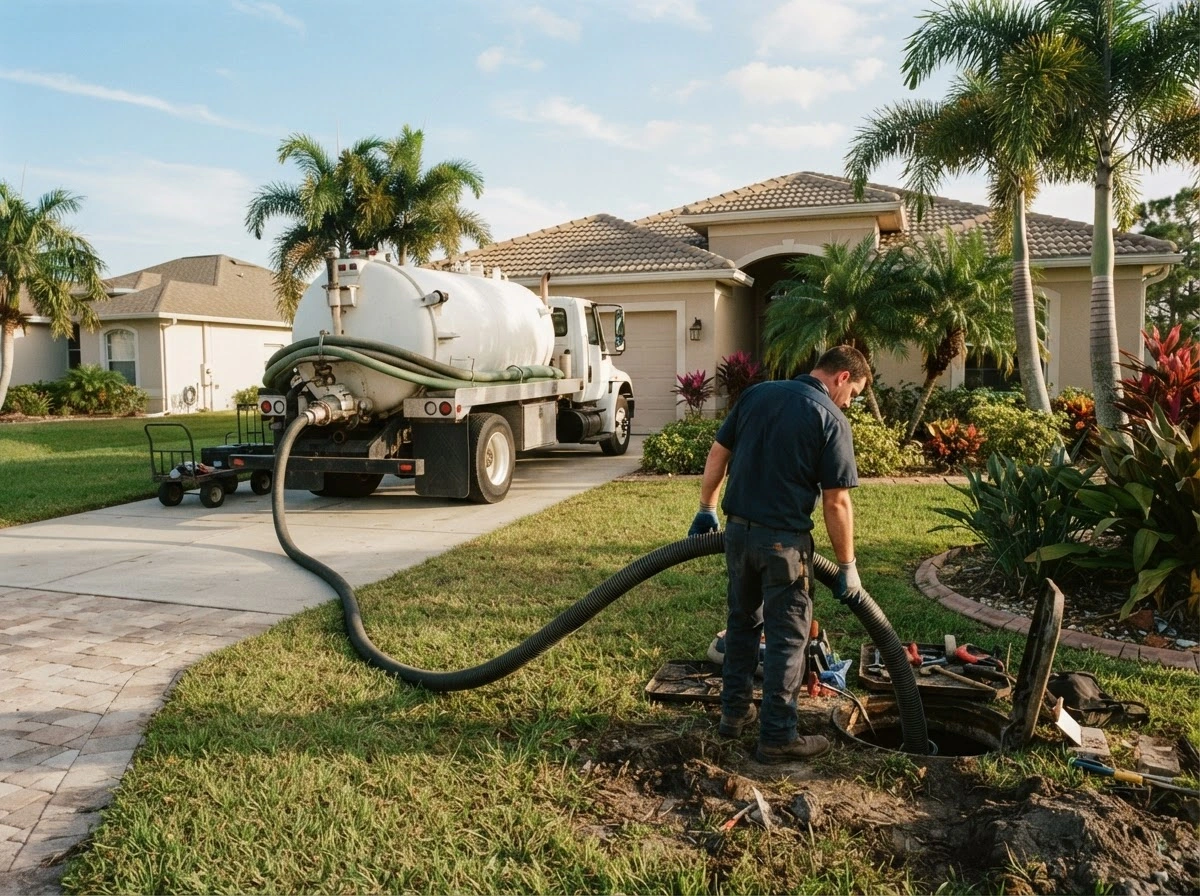
A small suburban lot in San Carlos Park with a septic tank lid in the yard

San Carlos Park

Septic tank pumping in San Carlos Park

Small lots, systems from the 1980s, and no sewer line on the schedule. Here is what that means for your tank.

State records list 2,427 San Carlos Park parcels as known septic, plus another 253 in a secondary permit class, against 728 connected to sewer. The county ranked this area 39th of 51 for conversion priority, and the utility's own service area map leaves it out. If you own here, a tank is what you have for the foreseeable future.

A subdivision platted before sewer came this way

San Carlos Park was laid out as a grid of small residential lots well before anyone ran a sewer main through it.

It is an unincorporated area of Lee County covering about five square miles, with US-41 along its western edge. The 2020 census counted 18,563 people and 7,255 housing units. The streets carry names like Island Park, Granada Lakes, Caloosa Trace, and Meadow Lake, and they were platted in the 1950s and 1960s on the assumption that each house would handle its own waste.

Most of them still do. The Florida Department of Health parcel inventory puts 2,427 parcels in the known septic class and another 253 in a secondary permit-backed class. Only 728 parcels show a sewer connection. A further 3,166 parcels sit in a modelled "likely septic" class that carries no permit record behind it, so treat that group as an estimate rather than a count.

Small lots and systems that are now 35 years old

Two numbers drive almost every job here. The average residential septic lot is 0.242 acres, and the median home was built around 1987.

On a lot that size there is room for one drainfield and not much else. A field gets sized to the soil and the number of bedrooms, and when the ground is tight the field is tight with it. There is usually no spare acreage to put a second one, which means a failed field is a harder problem here than it would be on a rural lot.

The age matters too. A system installed in 1987 has been in the ground close to four decades. Concrete tanks from that period are often still sound, but the baffles inside them are the parts that go first, and a broken baffle lets solids ride out into the drainfield. That is one of the few failures a pump-out can catch early, which is why it is worth looking inside the tank rather than just emptying it.

Why the county's conversion programme passes this area over

San Carlos Park holds the largest septic count of any area the county screened. It also sits near the bottom of the priority list.

Lee County's countywide wastewater plan, prepared by AECOM and published in March 2023, screened 51 candidate areas. San Carlos Park appears with 6,350 septic units, which is roughly nine times the next largest candidate. Its priority ranking is 39th of 51. The screening weighted each area by how close it sits to impaired water bodies, and San Carlos Park drains west and north rather than into the Caloosahatchee, which pulled its score down.

The plan also grouped the higher-ranked areas into ten recommended project clusters. San Carlos Park is not in any of them. Separately, Lee County Utilities' 2021 reclaimed water report describes the Three Oaks water reclamation facility service area as reaching from Estero Bay east to Ben Hill Griffin Parkway, and states it does so "excluding San Carlos Park."

Put those together and the practical answer is simple. There is no published date for a sewer connection here, and no funded project that would create one.
Mullock Creek, the flood maps, and your drainfield

Water leaving this area runs through Mullock Creek to Estero Bay. That path is the reason the ground under your drainfield behaves the way it does.

Mullock Creek is listed by the state as impaired for nutrients under WBID 3258C. It has no cleanup plan of its own, so no state rule attaches to it the way one would inside a basin management area. Testing by Calusa Waterkeeper in April 2024 recorded bacteria levels in the creek the group described as extremely high. Lee County has also been awarded around $7.1 million through the Rebuild Florida programme toward drainage work in the Mullock Creek basin.

The county's flood maps have been through a revision as well, with new maps published and a public comment period that ran through 2025. That matters for a septic system because a drainfield treats effluent in the gap between the trench bottom and the water table. When the table rises in the wet season, that gap narrows. Effluent that cannot move through the soil does not get treated, and it backs up instead.

If the ground over your field stays soft well into the dry months, the field is the problem rather than the tank. Pumping will not fix it, and the drainfield help page covers what can be done instead.

Where this comes up

Calls from San Carlos Park tend to fall into three groups, and each one leads somewhere different.

If you have bought the house recently and have no record of the last pump-out, start with tank cleaning and inspection. A visit establishes the tank size, its condition, and whether the baffles are intact. If the yard is already wet or the drains are slow, the drainfield is the better starting point, because that decides whether pumping is the right job at all.

For waste backing up inside the house, the emergency pump-out page sets out what to shut off while you wait. General figures on cost and pumping intervals are on the main septic tank pumping in Cape Coral guide.

Questions from San Carlos Park property owners

Is San Carlos Park ever getting sewer?

Nothing funded or scheduled points that way. The county ranked this area 39th of 51 for conversion priority, left it out of all ten recommended project groupings, and the utility's Three Oaks service area explicitly excludes it. A connection date would depend on a future programme that does not currently exist.

My lot is small. Can a new drainfield even be put in?

Sometimes, but it takes an evaluation rather than a guess. At 0.242 acres the constraint is real, and the answer depends on soil, the water table, and setback distances from the house and the property line. That is a licensed contractor's determination, and it is worth getting before you assume the lot is unusable.

The county plan says 6,350 septic units here. Why does the state say 2,427?

They measure different things. The 6,350 is a planning figure for the whole candidate area at an assumed density of about 2.5 units per acre. The 2,427 is a parcel count of records with a permit behind them. The permit-backed figure is the more conservative number, which is why it is the one used here.

My house was built in the 1980s. What should I check first?

The baffles inside the tank and the condition of the drainfield. Baffles are the parts that fail first on tanks of that age, and a broken one sends solids into the field where they cannot be removed. Both are visible during a routine visit, and both cost far less to deal with early than a field replacement does.

Nearby Areas We Serve

Get a Free Estimate in San Carlos Park

Tell us the address and what you're seeing, and we'll tell you what the tank likely needs.

Call (239) 737 3065

Free, with no obligation.

Call (239) 737 3065