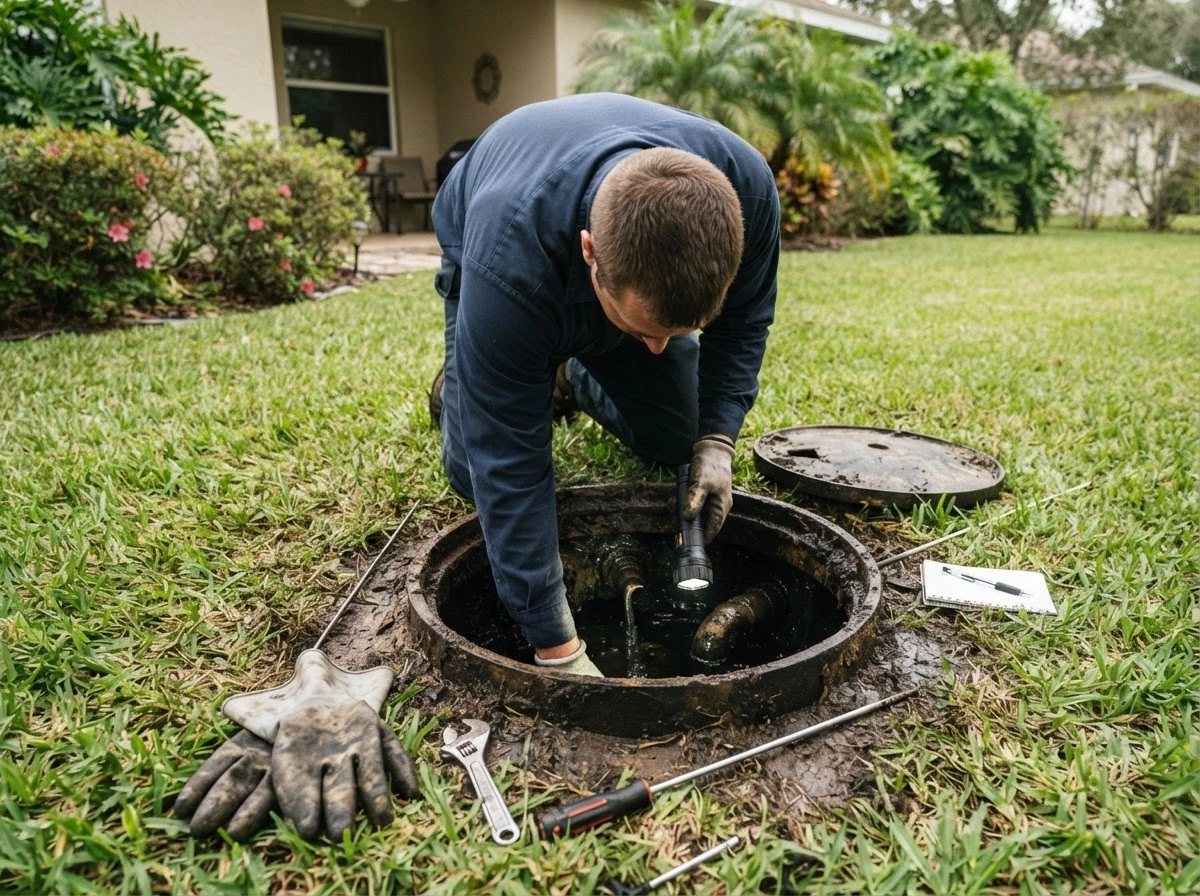
A septic tank access lid in a residential yard

Questions and Answers

Septic tank pumping questions, answered

The questions people ask before booking a visit, grouped so you can find yours quickly.

Most of what people want to know comes down to four things: what it costs, how often it is needed, how to tell something is wrong, and what to expect on the day. The answers below cover those in short form, with a link to the page that covers each one in full.

Start here

If you only read one thing, read this. The four answers below cover the questions behind most calls we get.

What it costs and how often it is needed are both on the main septic tank pumping in Cape Coral page, along with the warning signs and how the city's sewer conversion affects you. If you already know what you need and just want to book it, the contact page has the phone number and what to have ready. If you are choosing between services, the services page lists all six and what each one is for.

Cost questions

Is the estimate really free?

Yes. We quote before work starts and there is no charge for the quote itself. If you want a number before deciding anything, call and describe the property. You are not committing to a visit by asking.

Why do two quotes for the same tank differ?

Usually access. One company may have priced a lid sitting at ground level and the other priced digging for a buried one. Tank size, how full it is, and how far the hose has to run also move the figure. Ask what the quote assumes.

Does the price include disposal of what you pump out?

It should, and ours does. Septage has to be hauled to an approved disposal site, and that cost is part of the job. If a quote looks unusually low, ask where the waste goes and who pays for it.

Can the final bill be higher than the quote?

Only if something changes, and you hear about it first. A tank that turns out to be larger than described, or a lid that cannot be found where expected, can add time. We tell you before doing the extra work, not after.

Is there a charge if the lid is buried?

Often a small one, because locating and digging out a buried lid takes time. A riser fitted at ground level during the visit usually costs less than paying for the dig at every future pump-out.

Timing and scheduling questions

How long will the crew be at my property?

A standard residential pump-out runs one to three hours on site. A buried lid with no riser adds time, and so does a truck that cannot park close enough to reach the tank. For the full walkthrough, see how septic tank pumping works.

Can I book a specific day?

Usually yes, and it helps to book ahead if you want a particular week. Routine pump-outs are not urgent by nature, so there is no reason to take whatever slot is left. Call and we will tell you what is open.

Is there a best time of year to pump a tank?

Dry season is easier on everyone. Southwest Florida's wet season raises the water table, and pumping a tank while the ground around it is saturated is harder on the tank. It is not a reason to delay a tank that needs service, just a preference.

Does heavy rain mean I should pump sooner?

It can. Rain pushes more water through a system that is already full, and a high water table gives the drainfield less room to work. If your yard stays soft for days after a storm, that is worth mentioning. See drainfield help.

How far ahead should I book?

For a routine pump-out, a few days is usually enough. If you want a specific day or you are working around a real estate closing, give more notice. For a tank that has already backed up, say so on the call.

Questions about the visit itself

Do I need to be there?

No, as long as we can reach the tank and you have told us where it is. If the lid is buried or you are not sure where the tank sits, being there for the first few minutes makes finding it quicker.

Will the work tear up my yard?

Less than most people expect. The hose comes off a truck and goes to the tank lid, and the work area is limited to that path. A heavy truck on saturated ground can leave ruts, which is one reason dry season is easier.

What if I have no idea where the tank is?

That is common, and it is not a problem. We probe for the lid and can often narrow it down from the layout of the plumbing. A copy of your property survey or a septic permit record can help if you have one.

Do you need power or water from the house?

No. The truck carries its own pump and equipment. Nothing needs to be connected to the house, and nothing needs to be shut off beforehand. You do not need to be home to let anyone in.

What happens if you find a problem?

You get told before anything else happens. If the tank needs more than pumping, you will hear what and why. What we will not do is quietly add work to the job and explain it on the invoice.

Should I do anything to get ready?

Not much. Clear the path to the tank if you can, open any gate the crew needs, and keep pets inside while the work happens. If you know when the tank was last pumped, have that date ready.
System and property questions

Do you pump holding tanks and cesspools?

Yes. A holding tank has no drainfield and fills faster than a septic tank, so it needs pumping more often. A cesspool is an older design that works differently again. Tell us which you have when you call.

What about an aerobic treatment unit?

These have a pump, an aerator, and often an alarm, and they need different handling from a standard tank. Tell us what you have so the right equipment comes out. Inspections for these are covered under tank cleaning and inspection.

Can you pump out an RV or boat holding tank?

That depends on access and tank size, so ask when you call. Small portable tanks and marine systems are not the same job as a residential septic tank, and not every truck is set up for them.

What if the tank is under a deck or patio?

It can usually still be done, but it changes the job. Tell us before the visit so the crew arrives with the right approach. Sometimes an access point can be cut and refitted, and sometimes the hose can reach from the edge.

How do I find out what size my tank is?

Florida sets a floor by bedroom count, starting at 900 gallons for one or two bedrooms plus 150 for each extra bedroom. That is a minimum rather than a guarantee, so the only certain answer comes from looking. See how septic tank pumping works.

Service area questions

Which areas do you cover?

Cape Coral and five nearby towns: Fort Myers, North Fort Myers, Pine Island, Lehigh Acres, and San Carlos Park. The service areas page lists them all, with a page for each.

Do you charge more for outlying areas?

Availability and pricing can vary by distance, so the honest answer is that it depends where you are. Call with the address and we will tell you straight away rather than after a booking.

Do you work with restaurants and businesses?

Yes. Commercial grease trap service is a separate job from residential pumping, with its own equipment. Details are on the grease trap pumping page.

Do you handle the pump-out before a tank is abandoned?

Yes, and that is a growing share of the work as the city extends sewer. When a street connects, the tank has to be emptied before it is collapsed, and there is a deadline attached. See pre-abandonment pump-out.

Still Have a Question?

Call and describe the property. We will tell you what the tank likely needs and what it costs.

Call (239) 737 3065

Free, with no obligation.

Call (239) 737 3065