
How the Work Works
A full tank is a maintenance problem, not a mystery. Here is what comes out of the tank, why it builds up, and what sets how often you need it done.
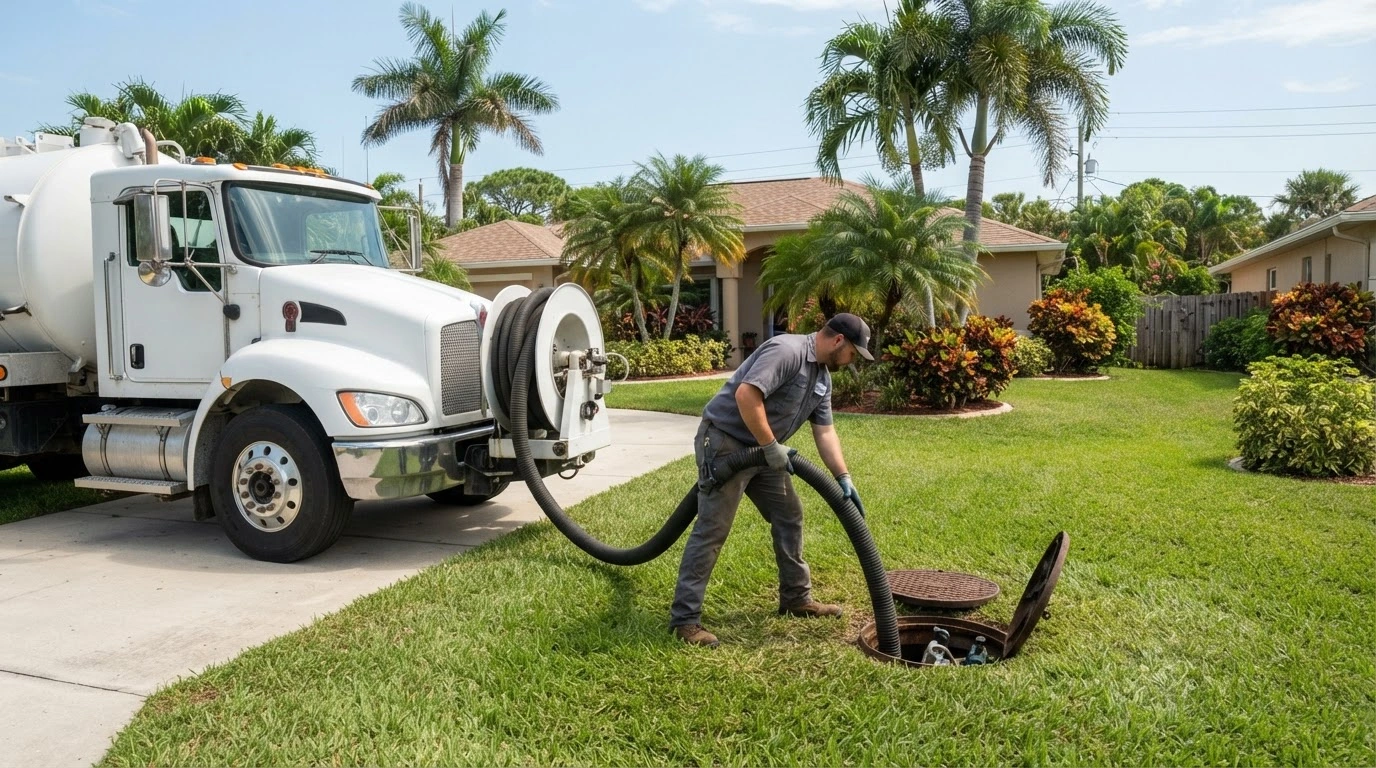
A vacuum truck pulls the contents out through the tank lid, breaking up the top layer first so the whole tank can be emptied. A standard residential tank takes one to three hours on site. What counts is emptying the tank completely, not skimming the top off.
Pumping removes the material that has collected in your tank since the last visit. The tank then goes back to holding what it was built to hold.
Your tank does three jobs at once. Heavy solids sink and form a sludge layer at the bottom. Grease and light waste float and form a scum layer on top. Between them sits the clearer liquid that drains out to the drainfield.
Bacteria work on all three layers, but they work slowly, and they cannot keep pace with what a household puts in. The sludge and the scum are what take up space over time. As those layers grow, the liquid layer shrinks, and waste has less time to settle before it leaves the tank.
Once solids start flowing out with the liquid, the drainfield is taking on material it cannot process. That is the real reason pumping matters. It is not about a tank filling up and overflowing. It is about the working volume shrinking until the tank stops doing its job. For local pricing and how often Cape Coral homes need this done, see septic tank pumping in Cape Coral.
Florida sets a floor for new tanks by bedroom count. A home with one or two bedrooms gets at least 900 gallons. Each extra bedroom adds 150 gallons, so a four bedroom house is looking at 1,200 gallons or more.
Those figures are minimums for new construction. Older homes were often built to a different standard, and two houses on the same street may not match. Size is only half of the picture. What goes into the tank matters just as much.
The visit follows the same order every time. Knowing it in advance takes most of the guesswork out of the day.
Lids and risers get located first, along with a look at where the truck can sit and how far the hose has to reach.
The scum layer is crusted over. It gets broken apart so the material underneath can be pulled out instead of sitting on top.
The vacuum truck pulls the liquid and solids out through the access point and into the tanker.
Once it is empty, the tank gets a look for cracks, baffle condition, and anything that needs a second visit. You hear what we found before we leave.
Most residential pump-outs finish in one to three hours. A buried lid with no riser adds time, and so does a truck that cannot park close enough to reach the tank.
Two tanks of the same size can cost different amounts to pump. These are the things that move the number.
We quote before we start. If we arrive and find something that changes the job, you hear about it before the work happens, not after.
The hardest part of septic upkeep is remembering when it was last done. A schedule you cannot recall is not much of a schedule.
Keep the receipt from every pump-out. Write the date on it if the invoice does not already carry one, and keep it somewhere you will look again. That single piece of paper turns your next decision into arithmetic instead of guesswork.
If you have no record, an inspection is the sensible starting point. It tells you how much has built up and whether the tank is close to needing service. From there, you can set an interval based on your household rather than a generic number.
Between visits, a few habits stretch the time between pump-outs. Do not pour cooking grease down a drain, and do not treat the toilet as a bin for wipes. Fix a running toilet quickly, because it pushes water through the system around the clock.
None of these replace pumping. They slow the clock on it.
Pumping is the routine job. These are the situations where it is not the whole answer, and where a different service applies.
If the tank is already backing up into the house, you need someone out rather than a scheduled visit. That is what our emergency pump-out page covers, including what to shut off while you wait.
If pumping keeps solving the problem for a few months and then it returns, the tank may not be the issue. Tank cleaning and inspection looks at baffles, cracks, and the parts of the system that pumping alone does not reach.
And if the ground over the drainfield is wet or the grass above it is unusually green, the tank may be fine while the soil is not. Drainfield help starts with reading those outdoor signs before you pay for the wrong service.
No, as long as we can reach the tank and you have told us where it is. Many customers are at work. If the lid is buried or you are unsure where the tank sits, being there for the first few minutes helps us find it faster.
Ask. The crew can show you the tank after pumping and tell you what the level looks like. A tank still holding liquid and solids is not empty, and you are entitled to see the difference before you pay.
Pumping done correctly does not harm either one. Problems come from two things: a truck that pulls the tank empty while the ground is saturated, which can make a concrete tank shift, and a tank left half empty so solids stay behind.
It is common, and it adds time rather than being a problem. We probe for the lid, dig down to it, and can fit a riser at ground level afterward so the next visit does not need the same work.
Tell us the address and what you are seeing, and we will tell you what the tank likely needs.
Free, with no obligation.